EQUIPMENT TO ENTERPRISE
Connect the equipment
you already operate.
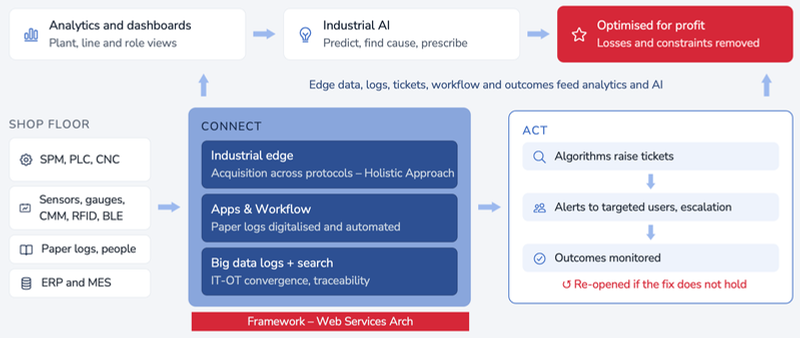
A manufacturing plant brings together different machine generations, controllers, gauges and sensors. StatPort’s industrial edge acquires, translates and transports their data, creating a usable path from equipment to operational insight.
CAPABILITIES
What it brings together.
01
Choose the right connection
Use available equipment logs and standard adapters where possible. Plan IoT hardware upgrades, sensors or relays where older assets need another route.
02
Translate the payload
Parse incoming machine and measurement records into a useful structure. Preserve the information needed to relate the signal to the operation.
03
Manage the data path
Connect edge records through API-based services. Monitor edge changes, industrial networks, deployed servers and web-service performance.
IN THE OPERATION
Map the source before selecting the interface.
A CNC machine, a PLC-controlled process and a measurement station will not necessarily expose data in the same way. Begin with the equipment’s actual capabilities and the question the data must answer. This defines the adapter, upgrade or sensor work required for a practical integration.
- Newer equipment with usable logs and systems supported through adapters.
- Older assets requiring IoT upgrades or sensor and relay inputs.
- CNC, PLC/SCADA, historians, measurement systems, drives and gateways.
- Edge-to-enterprise services connecting operational data with analytics and ERP.
A PRACTICAL APPROACH
Plan the whole route to the decision.
The integration is useful when the data arrives with enough context for a production, quality or maintenance decision. Establish the source interfaces, network boundaries, destination records and required operating response together. StatPort’s architecture considers IT–OT separation alongside edge-to-enterprise integration; the detailed design follows the plant’s infrastructure.
MEET THE EQUIPMENT WHERE IT IS
A connection path for each generation.
A practical connection path starts with the machine generation and the interface available. Some equipment supplies usable logs directly; other equipment needs adapters, an IoT upgrade or additional sensors.
Generation 4
Plug in where the machine already delivers usable data logs.
Generation 3
Use standard adapters for the interfaces available.
Generation 2
Provide the required IoT hardware upgrade.
Generation 1
Begin with sensors and relays to make the required signals available.
The data path can include measurement systems via Gageports, process streams from PLC tags and historians, and machine interfaces such as MTConnect. REST web APIs connect edge, big-data logs and OLAP, with IT–OT separation in the integration architecture.
CONNECTED THINKING
Keep exploring.
YOUR FACTORY. YOUR PRIORITIES.
Let’s connect your next step.
Start with your operating priorities. Explore the data, processes and people that can move them forward.