EDGE / CONTEXT / ANALYTICS
Give industrial data
a common working foundation.
Bring mixed equipment signals, enterprise information and human observations into a connected data architecture. Preserve the context that makes a record useful for production, quality, maintenance and management decisions.
CAPABILITIES
What it brings together.
01
Connect mixed generations
Plan around existing logs, adapters, IoT upgrades and sensor inputs. Match each connection to the equipment and the information the use case requires.
02
Build connected services
Move records from the edge to big-data and analytical layers through REST-based APIs—interfaces that let software services exchange information.
03
Retain operating context
Use document-based records, metadata and multiyear archives to keep the source and meaning of an observation available for later analysis.
IN THE OPERATION
A value needs more than a timestamp.
The same signal may describe different products, jobs or operating states. Useful industrial data management connects those meanings before teams rely on a dashboard or a prediction. StatPort brings equipment and business records together with digital forms, tickets and workflow outcomes, creating a foundation that can support more than one operating question.
- Translate and transport machine and measurement payloads.
- Connect industrial records with ERP and other enterprise information.
- Support unstructured information and records with descriptive metadata.
- Monitor edge, network, server and web-service operation across the data path.
A PRACTICAL APPROACH
Define the data path around its use.
Agree which sources are needed, what identifies each record and how information will reach the people using it. Include IT–OT network boundaries and the chosen on-premises, hosted-server or cloud deployment in that design. Then validate the path against one practical production, quality or maintenance application.
EDGE TO ENTERPRISE
Follow the record through the architecture.
Acquire and translate
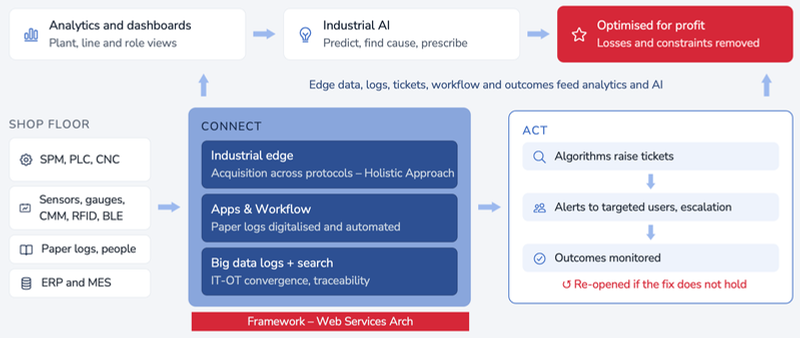
Sources described in the materials include machine controllers, process streams, gauges, paper logs and enterprise systems. Industrial-edge components acquire and parse the available data. Digital apps add human context so the operating record can represent more than the equipment signal alone.
Converge and make usable
The supplied architecture connects RESTful services, big-data logs, search and OLAP. The purpose is to make industrial records useful for traceability, analytical review and workflow. Define the relationships needed for the chosen process rather than assume that placing unrelated data in one store establishes its meaning.
Monitor and govern the path
Edge management includes keeping the framework and edge in sync and monitoring networks, servers and web-service performance. IT–OT separation is part of the described architecture. Establish hosting, access, source ownership and integration responsibilities with the plant’s technical teams during assessment.
CONNECTED THINKING
Keep exploring.
YOUR FACTORY. YOUR PRIORITIES.
Let’s connect your next step.
Start with your operating priorities. Explore the data, processes and people that can move them forward.