A maintenance team needs more than an indication that something has changed. It needs to understand the asset’s use, the work already carried out and the intervention that is practical now. Predictive maintenance becomes useful when analytical evidence joins that operating record and supports a defined response.
IN BRIEF
- Strengthen downtime and service records first.
- Choose signals around a maintenance question.
- Evaluate alerts with the people who must investigate them.
Choose an asset and a recurring question
Start with a problem the maintenance team already recognises: repeated downtime, uncertain service timing or a pattern of wear. Define the decision that earlier evidence could support. This keeps the pilot focused and helps identify the history required. Record the asset’s role in the process and the operating constraints that affect when an intervention can take place.
The source brochure brings maintenance, asset life, calibration and asset tracking into the same discussion. Those needs should not be collapsed into one generic prediction. A recurring breakdown, a gauge-calibration requirement and an asset-location question involve different evidence and responsible people. Name the first use case precisely so the team can recognise what the pilot should help them decide.
Build a dependable maintenance history
Bring preventive-maintenance schedules, downtime events, service work and spares usage into a shared record. Check that each event identifies the right asset and includes enough detail to distinguish the issue from the repair. StatPort supports digital schedules, IoT-based downtime capture and ERP links for spares and costs, providing a starting point for reviewing recurring asset problems.
Mean time to repair (MTTR) and mean time between failures (MTBF) appear in the supplied maintenance scope, together with downtime capture and preventive-maintenance schedules. A useful review keeps the underlying events accessible. The headline measure should lead back to an identifiable asset and service record, allowing the team to examine the recurrence rather than debate a summary with no supporting detail.
Select the evidence that fits the question
Condition measurements can add useful information, but first ask what they would help explain. Usage, workload, downtime patterns and maintenance history may also matter. The Stat AI material describes prediction with and without condition monitoring. Determine which evidence is available for the chosen use case rather than assume that adding a sensor will, by itself, make a reliable prediction possible.
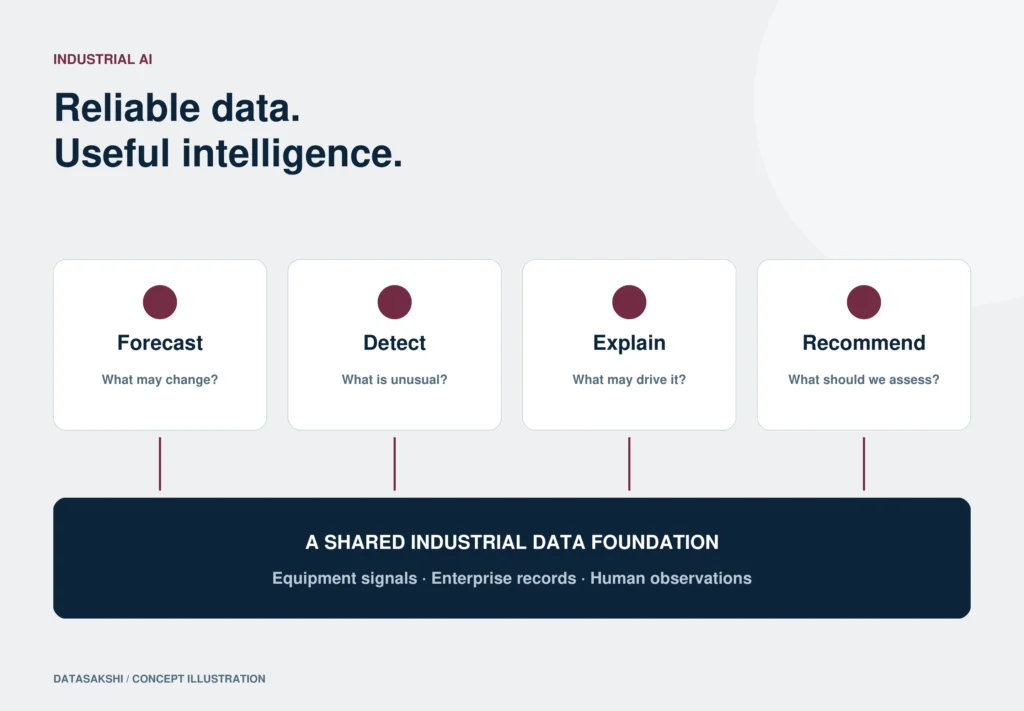
The Stat AI appendix combines forecasting, anomaly detection, root-cause analysis and predictive-maintenance recommendations. The brochure also states that prediction models are available with and without condition monitoring. That does not make evidence optional. It means the assessment should establish which records are suitable for the question and where additional measurements or cleaner maintenance history are needed.
Connect the signal to an investigation
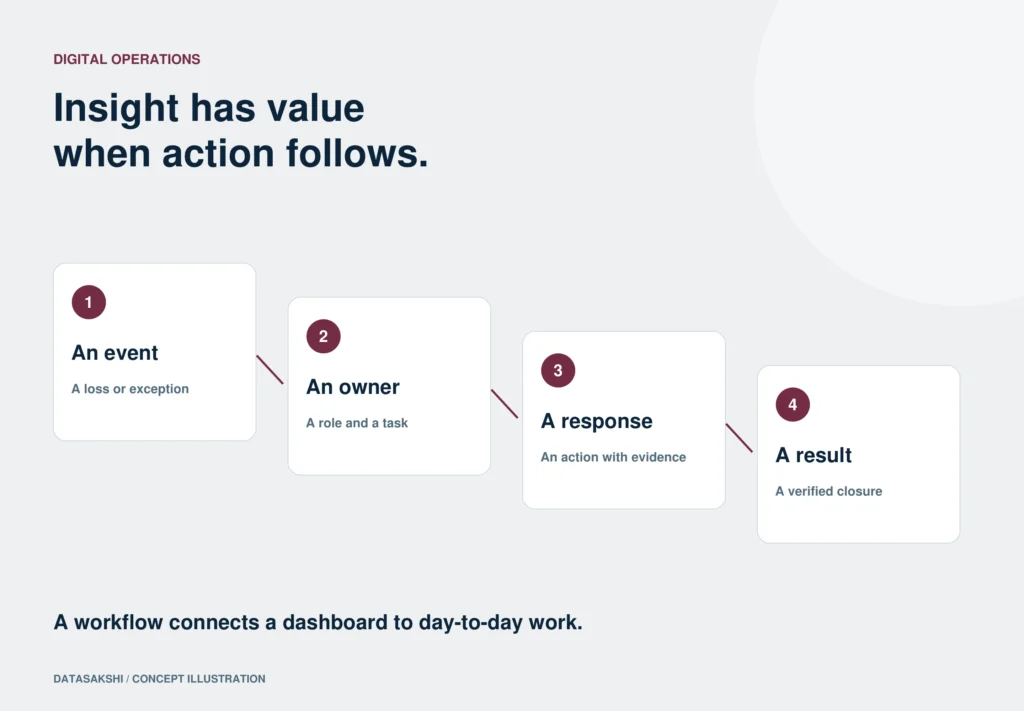
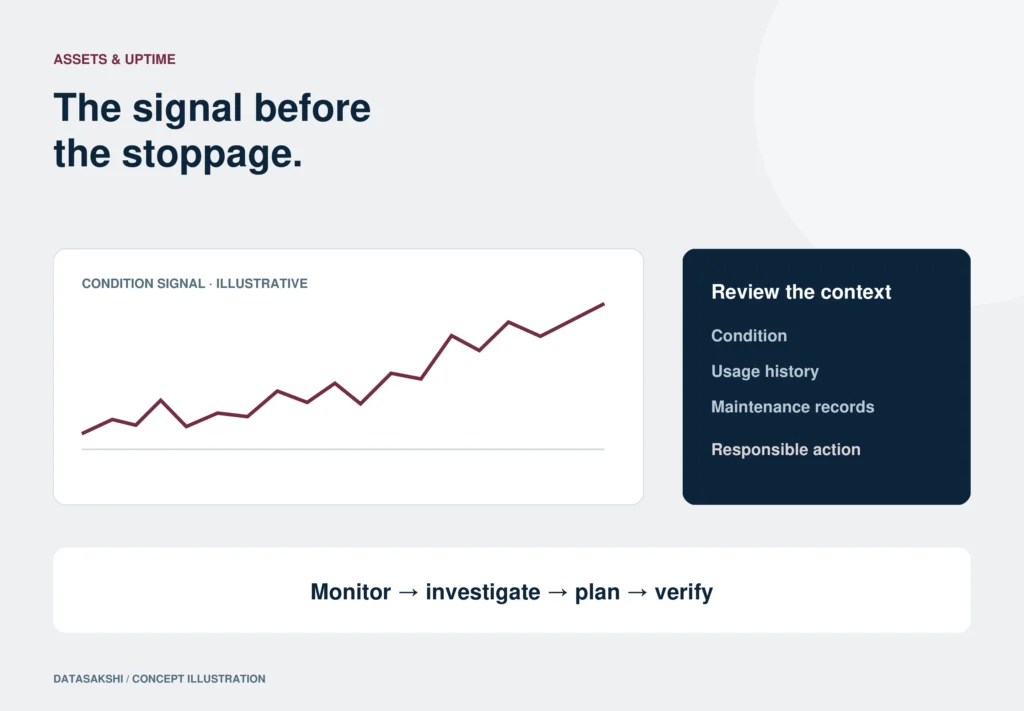
Agree who receives the finding, what context accompanies it and how the team records the outcome. A warning may lead to an inspection, a planned service review or further observation. Review the confidence and supporting evidence before selecting a response. Keep the investigation linked to the asset record so later analysis can distinguish a useful signal from an unhelpful repeat alert.
A maintenance signal should enter the existing decision process with a responsible role, the asset context and a suitable review point. Keep the distinction between a software recommendation and an authorised intervention. Engineers still need to consider the production plan, the relevant safety procedures and the practical service conditions before taking action. The platform’s role is to make the supporting information easier to follow.
Judge the pilot on practical usefulness
Stat AI’s predictive-maintenance approach is pilot-ready and combines forecast, anomaly and root-cause evidence. Evaluate whether the information helps prioritise attention and fits the maintenance routine. Track the review effort as well as the findings. Expand once the team understands where the output is useful, which conditions limit its interpretation and what data or workflow needs strengthening.
The brochure contains promotional improvement figures, but they are not a substitute for the baseline of a particular plant. Agree what will be measured in the pilot and keep the conditions comparable. Useful outcomes may include clearer prioritisation and better investigation records; the actual effect on downtime must be established from the agreed operating evidence rather than promised in advance.
ILLUSTRATIVE SHOP-FLOOR SCENARIO
From a recurring stoppage to a planned review
Imagine an illustrative line with repeated short stoppages and several maintenance visits recorded under broad descriptions. Before choosing a prediction target, the team brings together the events, asset identity, work performed and production context. A risk view then becomes a prompt for a qualified review, not a replacement for the service record.
The planner records what was inspected, what action was authorised and what the next operating period showed. An unhelpful signal is retained for the pilot review as well. No machine should be stopped, adjusted or returned to service solely because an illustrative forecast screen suggests an action. This example describes the review workflow, not an engineering instruction.
Bring these questions to the first review.
- Which recurring asset problem is worth earlier attention?
- Is downtime linked to identifiable service work?
- Who reviews the signal before an intervention?
- How will usefulness, false alarms and review effort be assessed?
Source notes & editorial boundaries
November capability brochure, pages 10–11; November presentation, slides 19 and 21. Maintenance scenarios are editorial illustrations, not safety or machine-service instructions.
This article is prepared from DataSakshi’s supplied materials. Product statements retain their stated scope. Practical examples are illustrative, not customer testimonials or performance promises.