MAINTENANCE / CALIBRATION / TRACKING
Know the asset.
Plan the next intervention.
Connect maintenance schedules, downtime, usage, calibration and service history. Give reliability teams a dependable record for routine asset care and a foundation for predictive-maintenance pilots.
CAPABILITIES
What it brings together.
01
Maintenance and downtime
Digitalise preventive-maintenance schedules, capture downtime with IoT and link spares and costs to ERP. Review mean time to repair (MTTR) and mean time between failures (MTBF).
02
Calibration and gauges
Support measurement-system analysis and gauge repeatability and reproducibility studies. Manage issue, return and calibration workflows alongside each gauge’s record.
03
Identity and service life
Connect asset identification, location, usage and service activity. Examine life versus use, wear and remaining-life assessments in their operating context.
IN THE OPERATION
Give each intervention a useful history.
A maintenance signal becomes more meaningful beside the work already done on the asset. Digital schedules, service records and downtime history help teams understand recurring problems and plan the response. StatPort connects this everyday discipline with condition evidence and pilot-ready Stat AI analysis where a predictive use case is appropriate.
- Record preventive-maintenance activity and IoT-based downtime.
- Link spares, service work and cost information with enterprise records.
- Manage gauges, measurement studies and calibration sequences.
- Use barcode, QR, RFID or BLE approaches to connect identity and location.
A PRACTICAL APPROACH
Progress from a reliable record to a focused prediction.
Select an asset and a maintenance decision that could benefit from earlier evidence. Review usage, downtime and service history before deciding which signals or analytics to add. Agree who will investigate an alert, what response is practical and how the usefulness of the pilot will be assessed.
MAINTENANCE + ASSET CONTEXT
Give each intervention a record worth returning to.
Maintenance and service history
The brochure describes digital preventive-maintenance schedules, IoT downtime capture, MTTR and MTBF, and links to ERP for spares and costs. Bring those records together around the asset so the team can examine repeated problems without reconstructing the history from separate reports.
Calibration and asset identity
The wider scope includes measurement-system analysis, gauge R&R, gauge issue and return, and calibration workflows. Barcode, QR, RFID and BLE are listed as asset-identification approaches. The suitable method depends on the asset and operating requirement agreed during assessment.
A defined predictive application
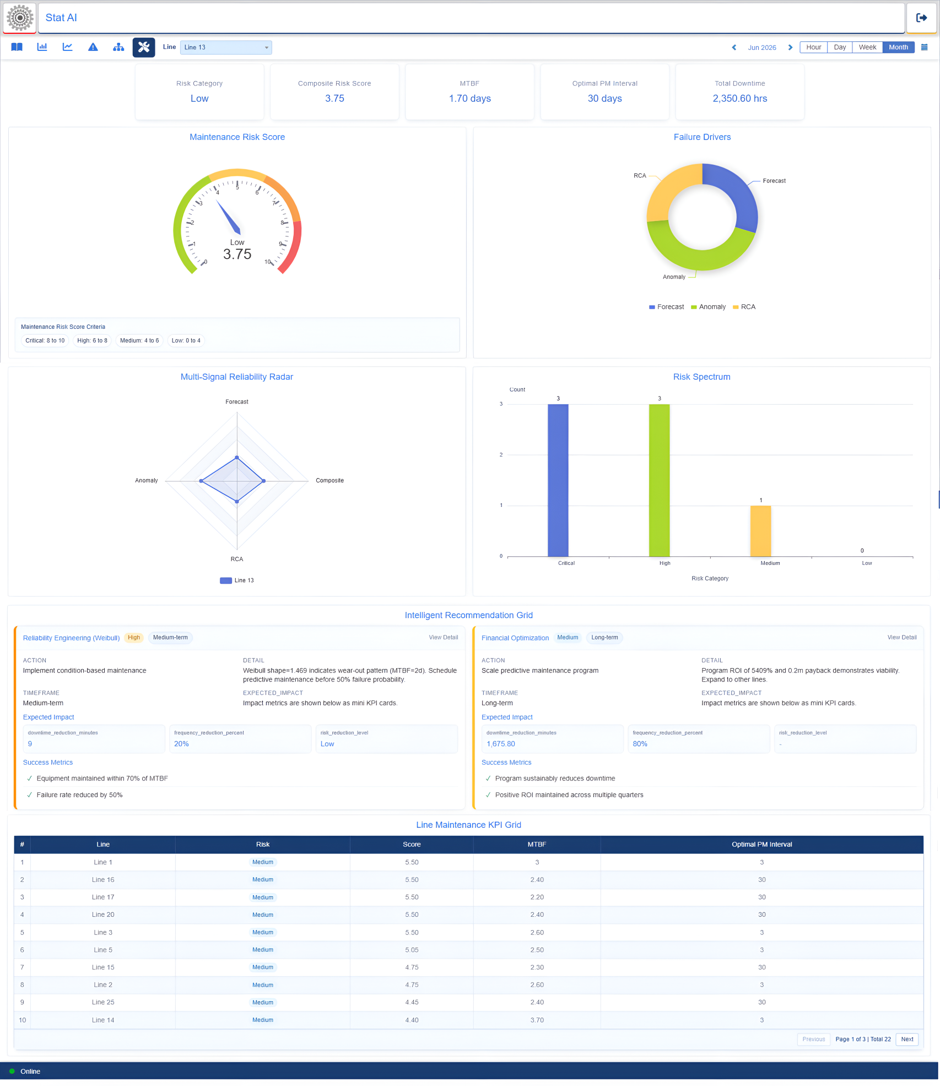
Stat AI introduces forecast, anomaly and root-cause views for a focused maintenance pilot. Establish available history, the responsible reviewer and the intervention decision. Analytical recommendations support the maintenance process; they do not replace qualified engineering judgement or authorise equipment changes.
PREDICTIVE MAINTENANCE
Read the risk beside the recommended response.
The predictive-maintenance view brings forecast, anomaly and root-cause signals into a maintenance risk score. It includes MTBF, an optimal preventive-maintenance interval per line and an intelligent recommendation grid. Together, these views support a move from scheduled maintenance towards a more focused intervention.
CONNECTED THINKING
Keep exploring.
YOUR FACTORY. YOUR PRIORITIES.
Let’s connect your next step.
Start with your operating priorities. Explore the data, processes and people that can move them forward.